Issue:
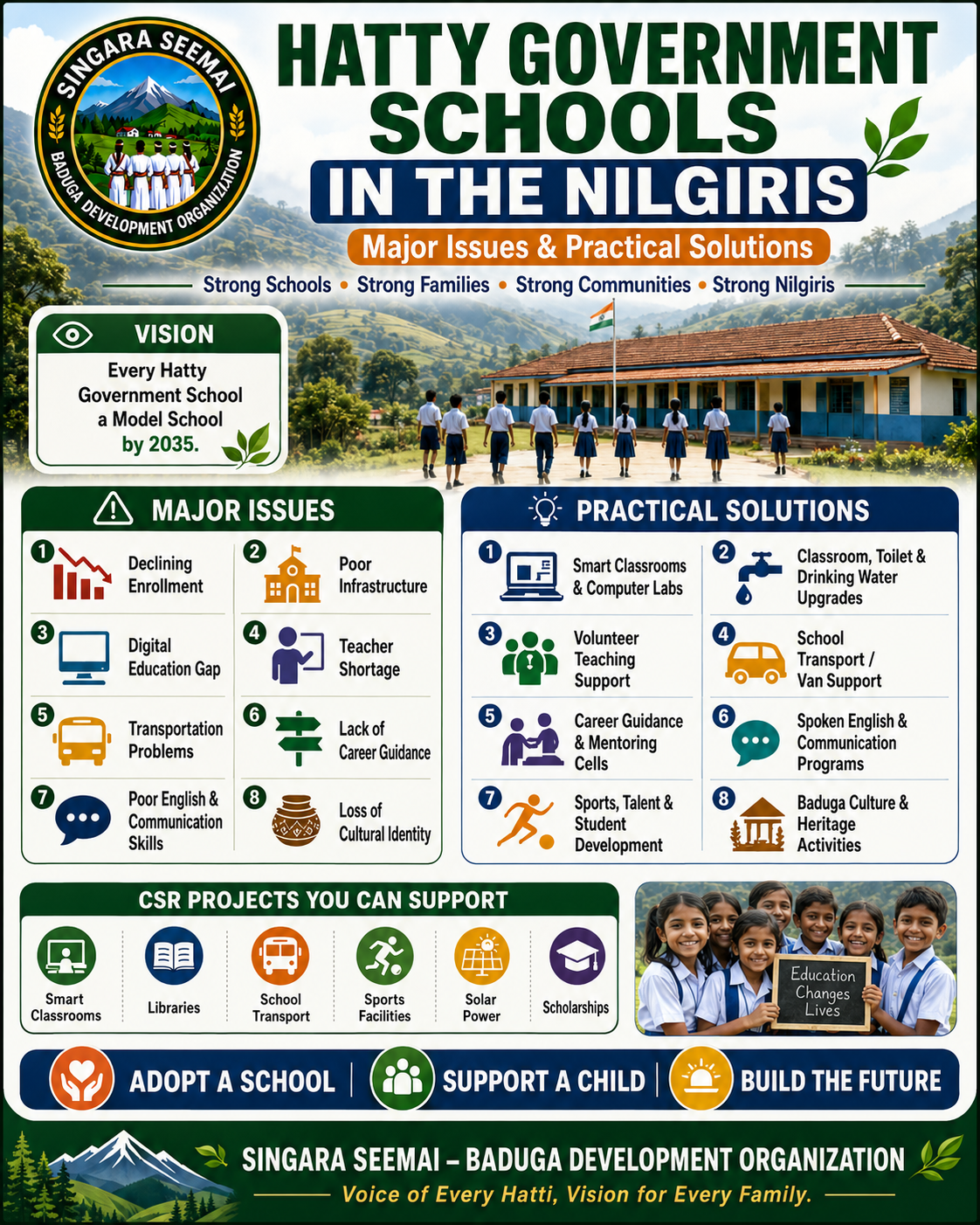
Many Hatty Government Schools are losing student strength due to migration, preference for private schools, limited facilities, and lack of awareness among parents.
Solution:
Improve school infrastructure, introduce smart classrooms, provide quality teaching support, organize parent awareness meetings, and promote “Our Hatty School – Our Responsibility” campaigns. Model school development will increase trust and enrollment.
Issue:
Some schools need better classrooms, furniture, toilets, drinking water, compound walls, playgrounds, and safe learning spaces.
Solution:
Implement CSR-based school infrastructure development. Companies, alumni, and community donors can support classroom renovation, modern toilets, safe drinking water, furniture, solar power, and playground development.
Issue:
Many rural students do not have access to smart classrooms, computers, internet, digital learning tools, and online education support.
Solution:
Create digital learning centres in every selected Hatty school with smart boards, projectors, computer labs, high-speed internet, e-learning content, and basic computer training.
Issue:
Teacher shortage, frequent transfers, and lack of subject experts affect learning quality.
Solution:
Create a community volunteer teaching network. Retired teachers, graduates, professionals, college students, and online tutors can support students in English, Maths, Science, Computer Skills, and competitive exam basics.
Issue:
Students from remote Hatties face travel difficulty, poor road access, limited public transport, and safety issues.
Solution:
Develop community-supported school transport solutions such as shared vans, safe transport routes, student pickup points, and CSR-supported school buses for remote areas.
Issue:
Students are not fully aware of higher education, scholarships, government jobs, private jobs, skill courses, and professional career options.
Solution:
Establish Career Guidance and Mentoring Cells in Hatty schools. Conduct monthly awareness sessions on higher education, scholarships, engineering/medical/arts courses, TNPSC, UPSC, banking, defence, police, and job opportunities.
Issue:
Many students have talent but lack confidence in English, public speaking, communication, and interview skills.
Solution:
Start free spoken English, reading, storytelling, public speaking, debate, handwriting, and communication skills classes through online and offline modes.
Issue:
Many schools lack sports grounds, equipment, coaches, cultural programs, arts, music, drawing, dance, and talent development opportunities.
Solution:
Provide sports kits, organize annual Hatty school sports meets, talent competitions, cultural events, art workshops, music and dance training, and personality development programs.
Issue:
Students need confidence, motivation, counselling, emotional support, and life skills guidance.
Solution:
Introduce student mentoring, motivational talks, life skills training, counselling support, exam stress management, and confidence-building sessions with teachers, psychologists, professionals, and volunteers.
Issue:
Children are slowly losing connection with Baduga language, heritage, traditions, values, songs, and community identity.
Solution:
Introduce cultural learning activities such as Baduga language awareness, traditional songs, history sessions, cultural storytelling, heritage days, traditional dress days, and community elders’ interaction programs.
Issue:
School development is weak when parents, alumni, local leaders, and volunteers are not actively involved.
Solution:
Form a Hatty School Development Committee with parents, teachers, alumni, youth volunteers, elders, CSR partners, and local well-wishers. Conduct quarterly review meetings and publish transparent progress updates.
Issue:
Students need early exposure to AI, coding, robotics, digital tools, environmental education, entrepreneurship, and innovation.
Solution:
Start Future Skills Clubs in Hatty schools covering computer basics, AI awareness, coding basics, robotics demos, digital safety, environmental projects, agriculture innovation, and problem-solving activities.
Identify school strength, infrastructure gaps, digital needs, transport issues, and student requirements.
Select schools based on student strength, urgency, community participation, and long-term impact.
Connect companies, alumni, professionals, and well-wishers to adopt schools or sponsor specific projects.
Start infrastructure, digital learning, library, sports, career guidance, and student development activities.
Conduct regular monitoring, collect feedback, document progress, and share transparent reports with the community.
Every Hatty Government School will be a Model School by 2035.

Hatty school children need more than classroom education. They need good health, confidence, values, digital exposure, communication skills, career guidance, sports, culture, and family support. A child’s lifestyle today decides the community’s future tomorrow.
Every Hatty child should receive proper academic support in English, Maths, Science, Social Science, and Computer Basics. Free evening classes, weekend coaching, online mentoring, and volunteer teaching can help students improve their learning level.
Action Plan:
Good health is important for good learning. Many children need awareness about nutrition, hygiene, physical fitness, and mental wellness.
Action Plan:
Children from Hatties should not be left behind in the digital world. They must be introduced to computers, internet safety, AI basics, coding, digital learning, and smart classroom tools.
Action Plan:
Many rural students have talent but lack confidence in speaking, presenting, and expressing ideas. Communication skills will help them in higher education, interviews, and leadership.
Action Plan:
Students should know about future career options from school level itself. They need guidance on higher education, scholarships, government jobs, private jobs, professional courses, and skill-based careers.
Action Plan:
Children should be encouraged to develop their natural talents. Sports, drawing, music, dance, chess, writing, cultural activities, and competitions help build confidence and discipline.
Action Plan:
Modern education should grow along with cultural identity. Children should learn about Baduga language, traditions, songs, dress, history, respect for elders, community values, and environmental responsibility.
Action Plan:
Children’s development is possible only when parents, teachers, alumni, youth, and community members work together.
Action Plan:
Some children need support for books, uniforms, transport, school fees, digital devices, and learning materials.
Action Plan:
Every Hatty school child should have a clear future pathway from school to higher education, skill training, employment, entrepreneurship, or government service.
Development Pathway:
School Education → Skill Training → Higher Education → Career Guidance → Job / Business / Government Service → Community Leadership
Educate Every Child – Academic support and digital learning
Empower Every Youth – Skills, confidence, and career guidance
Support Every Family – Health, livelihood, and awareness
Elevate Every Hatti – Strong schools, strong culture, strong future
To make every Hatty child educated, healthy, confident, skilled, culturally rooted, and future-ready.