Subscribe To Our Newsletter
Lorem ipsum dolor sit amet consectetur adipisicing elit. Nesciunt, reprehenderit!

Agriculture
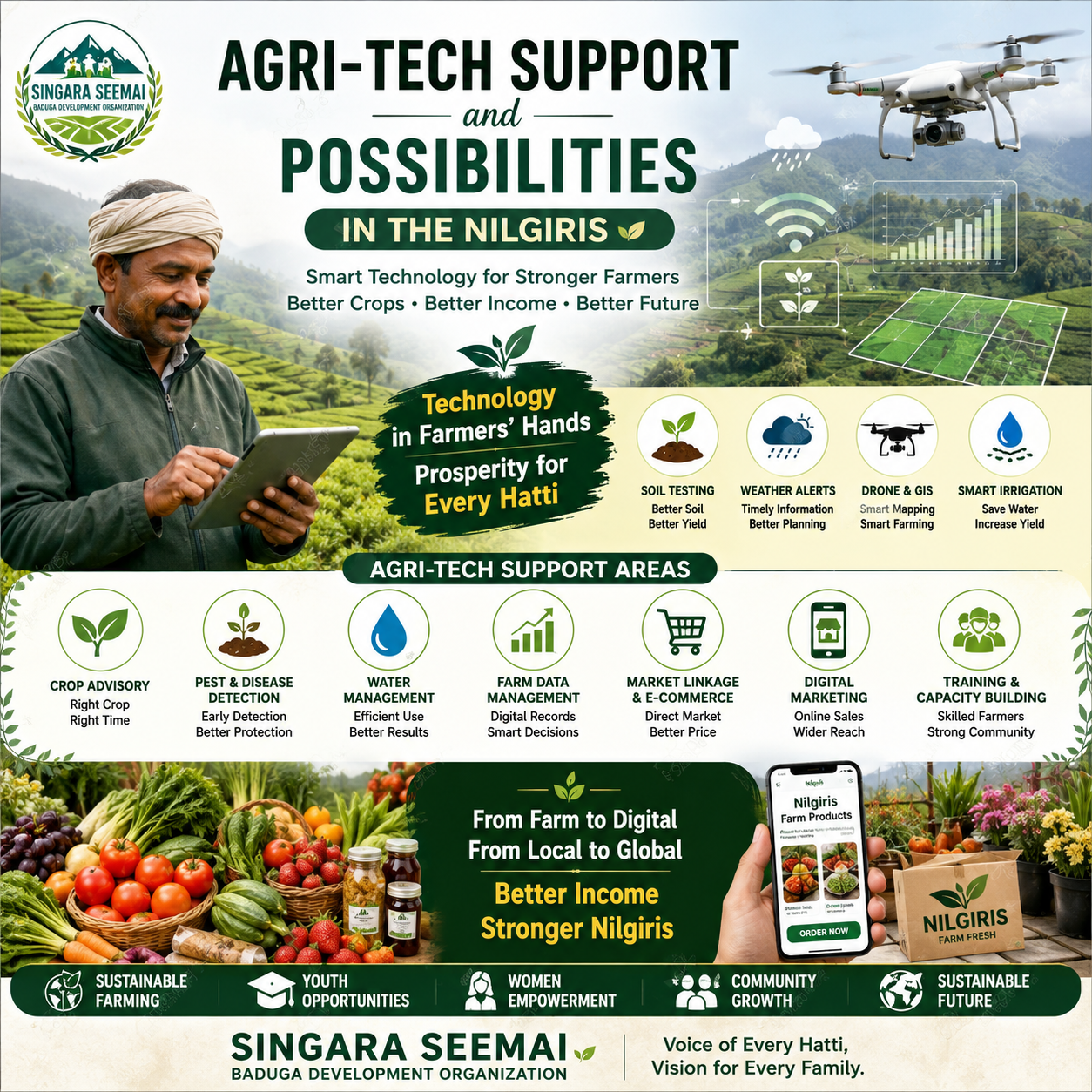
The Nilgiris has strong agricultural potential through tea, vegetables, fruits, berries, herbs, flowers, millets, spices, and nursery crops. However, farmers are facing many challenges such as climate change, unstable prices, soil health issues, water shortage, wildlife problems, labour shortage, and lack of direct market access.
Agri-Tech Support can help farmers use modern technology for better planning, better crop management, better yield, lower cost, and better income. By combining traditional farming knowledge with digital technology, the Nilgiris can become a model hill agriculture region.
Agri-tech can support farmers in making data-based decisions. It helps identify the right crops, monitor soil and weather conditions, reduce crop loss, improve quality, connect farmers with buyers, and create digital records for future planning.
1. Soil Testing and Crop Advisory
Soil testing can help farmers understand soil nutrients, pH level, organic matter, and crop suitability. Based on the soil report, farmers can select suitable crops and reduce unnecessary fertilizer usage.
2. Weather-Based Farming Alerts
Digital weather alerts can help farmers plan irrigation, spraying, harvesting, and crop protection. This is very useful in the Nilgiris because rainfall, mist, and temperature changes affect crop quality.
3. Drone Mapping and Farm Survey
Drones can be used for farm mapping, crop monitoring, slope analysis, water flow study, pest identification, and plantation planning.
4. GIS-Based Land and Crop Planning
GIS mapping can help identify suitable areas for tea, herbs, vegetables, fruits, floriculture, millets, and nursery crops. It can also support water planning and landslide-risk awareness.
5. Smart Irrigation Support
Sensor-based irrigation can help farmers use water efficiently. This is useful for vegetable farms, nurseries, fruit farms, and herbal crops.
6. Digital Farmer Database
A digital farmer database can record farmer details, land area, crop type, production capacity, market needs, and training requirements. This will help in planning community-level agriculture development.
7. Market Linkage and E-Commerce Support
Farmers can use WhatsApp, websites, social media, digital catalogues, QR codes, and e-commerce platforms to sell products directly to consumers, hotels, resorts, organic stores, and urban buyers.
8. AI-Based Crop Recommendation
AI tools can suggest suitable crops based on soil, climate, market demand, water availability, and land size. This can help farmers choose profitable and sustainable crops.
9. Pest and Disease Detection
Mobile-based image analysis and expert support can help farmers identify crop diseases early and take preventive action.
10. Farm-to-Consumer Digital Platform
A digital platform can list Nilgiris products such as tea, vegetables, fruits, herbs, millets, flowers, honey, spices, and nursery plants for direct orders.
Agri-tech can create new opportunities for educated youth in the Nilgiris. Youth can support farmers through drone services, soil testing, digital marketing, product photography, e-commerce management, data collection, farm mapping, mobile app support, and online buyer coordination.
Singara Seemai can develop a community-based agri-tech support system for farmers by creating:
To make Nilgiris agriculture smarter, more profitable, climate-resilient, technology-enabled, and youth-driven through agri-tech support.
Lorem ipsum dolor sit amet consectetur adipisicing elit. Nesciunt, reprehenderit!